

Open LLM Leaderboard
An open-source LLM leaderboard by Hugging Face
- Category
- LLM Benchmarks
- Listed on
What is Open LLM Leaderboard?
Open LLM Leaderboard is an open-source large language model ranking platform built by Hugging Face, the largest community for models and datasets. It is powered by the Eleuther AI Language Model Evaluation Harness and evaluates models across multiple benchmarks, including IFEval, BBH, and MATH, covering dimensions such as instruction following, complex reasoning, mathematical problem-solving, and domain-specific knowledge. The leaderboard covers a wide range of model types, from pretrained models to chat-tuned variants, and provides detailed numerical scores along with input/output samples for each model. By helping users identify the most capable models available, Open LLM Leaderboard drives progress across the open-source AI community.
How to use Open LLM Leaderboard
- Visit the leaderboard page: Navigate to the Open LLM Leaderboard page to view current model rankings and performance data.
- View model details: Click on any model name that interests you to see its detailed information.
- Filter and compare models: Use the filtering options on the leaderboard page to narrow down models by type, performance metric, or other criteria. Compare how different models perform across benchmarks to find the best fit for your needs.
- Reproduce evaluation results: If you need to reproduce a model's evaluation results, use the code tools provided by Hugging Face:
- git clone git@github.com:huggingface/lm-evaluation-harness.git cd lm-evaluation-harness git checkout main pip install -e . lm-eval --model_args="pretrained=<your_model>,revision=<your_model_revision>,dtype=<model_dtype>" --tasks=leaderboard --batch_size=auto --output_path=<output_path>
- Replace <your_model>, <your_model_revision>, and <output_path> with your actual values. For instruction-tuned models, add the --apply_chat_template and --fewshot_as_multiturn flags.
Key features of Open LLM Leaderboard
- 1
Multi-Dimensional Benchmarking
Runs a suite of benchmarks including IFEval, BBH, MATH, and GPQA, covering instruction following, complex reasoning, mathematical problem-solving, and domain-specific knowledge to deliver a comprehensive assessment of model capabilities.
- 2
Support for Multiple Model Types
Supports pretrained models, continually pretrained models, domain-specific fine-tuned models, and chat models, covering a broad range of use cases.
- 3
Detailed Result Display
Provides granular numerical scores along with model input and output details, giving users deep insight into how each model performs.
- 4
Community Engagement
Community members can tag and discuss models, helping ensure the leaderboard remains fair and transparent.
- 5
Reproducibility Support
Ships with code and tooling that let users reproduce leaderboard results, strengthening the credibility of research findings.
Use cases of Open LLM Leaderboard
- 1
Model Evaluation and Selection
Developers and researchers can quickly identify the best open-source language model for specific tasks such as customer service automation or content generation.
- 2
Academic Research
Offers a unified benchmarking platform for academics to evaluate model performance and advance the state of language model technology.
- 3
Community Engagement
Fosters interaction within the open-source community by encouraging developers to submit their models and share research outcomes.
- 4
Education and Learning
Serves as an educational resource, helping students and newcomers understand language model evaluation methodologies and performance metrics through hands-on practice.
- 5
Technical Validation and Comparison
Validates whether a newly developed language model meets industry standards and helps identify strengths and weaknesses by comparing it against other models.
More in LLM Benchmarks
View all
AI Large Model Evaluation Community

Biomedical research QA dataset and model leaderboard
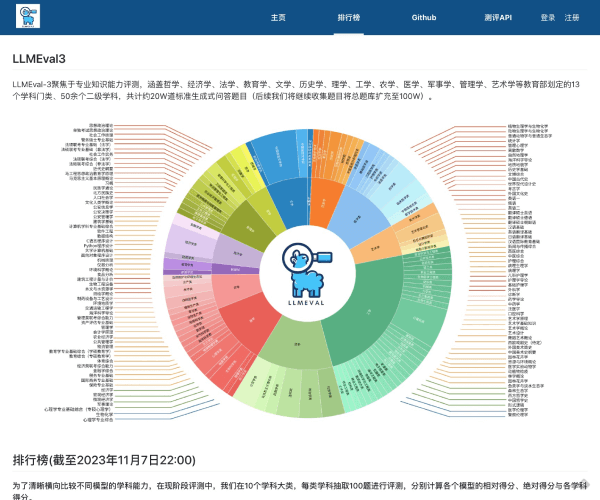
A large language model benchmark from Fudan University's NLP Lab

Stanford's comprehensive evaluation framework for large language models